My London Your London

A cultural guide

Page 41 of 42

Review: Samuel Palmer at the British Museum

The introduction to Samuel Palmer: Vision and Landscape describes the artist as “one of Britain’s greatest painters”. Certainly a couple of his works are among of the nation’s most reproduced. And this exhibition, which traces his entire career, suggests that “one of the most talented” would be a fair label. Overall, however, what is on display is a talent dissipated by the pressures of Victorian life.

The British Museum exhibition traces in detail not just his work, but his curiously modern life. A self-portrait at the age of about 19 shows a soulful young man, far too serious for his age. A Romantic, destined to die young, you would think. Yet his work at this time is conventional, picturesque landscape – one watercolors closely resembling a painting manual’s model. (Echoes of the Vettriano controversy.)

But soon he was to find a mentor. He credited the artist John Lunnell with his transformation, describing him as “a good angel from Heaven to pluck me from the pit of modern art”. A sketchbook from 1824 shows a study of “The Bad Thief”, a powerful, contorted figure menaced by a shark-mouthed Satan.
Continue reading
Theatre Review: The Emperor Jones at The Gate

That a play written in 1920 should still feel entirely fresh and relevant 85 years later is either the sign of a fine drama, or of a failure of the human race to progress. In the case of Eugene O’Neill’s The Emperor Jones, both statements are true.

When Brutus Jones (Paterson Joseph) swaggers muscularly into the Gate Theatre, revealing within seconds the nature of his regime, built entirely on brutality and bombast, recent parallels are obvious. Robert Mugabe sweeps into mind, then Ceascescu, Mobutu … the list could go on and on.

And as America struggles to find “leadership material” in Iraq, O’Neill’s play presents a society entirely corrupted by the exercise of absolute, violent power. There are no heroes here – it is the power of the Emperor’s own conscience that will really get to him.
Continue reading

Listening to history: Fashion Lives at the British Library

Lily Silberberg’s story might be that of the 20th century – the good side of the period, not its darker hue. She was born in London in 1929, to Jewish parents whose had fled Russia after the Revolution. Her father was a “journeyman tailor”, her mother an outworker spending her evenings sewing buttonholes late into the night by the light of a gas lamp.

Yet by the time Lily retired, well into her seventies, she had a full, satisfying, successful career behind her. She’d been a respected higher education lecturer, published a book, The Art of Dress Modelling, and spent the last years of her working life teaching her skills to the Bangladeshi community in Tower Hamlets.

Not bad for a girl who’d at the age of 13 had been sent by her parents – no doubt scraping hard for the fees – to the then Barrett St Technical College (now the London College of Fashion) for a two-year course “intended to take the place of an apprenticeship”. (Gentility came with an optional course in French, two hours a week.)

She’d been a star pupil, yet Lily speaks of the shock of going on to the factory floor. “The standards I’d been taught were of the highest haute courture, the standard of the Queen’s coronation robe. But there had been a war and a revolution in the garment industry. … They would shout at me in the factory: ‘Time is money.’ Can you imagine a bit of confusion?”

British Library
Some of her earliest efforts, tremendous labour for such small results, are on display in the British Library’s Fashion Lives exhibition. There’s a neat bunch of red roses embroidered on a handkerchief, made with, we are told, “material of a nightdress that belonged to her mother”.

But there’s a lot more to the exhibition than objects, books and pictures, fabulous as some of those are.
Continue reading

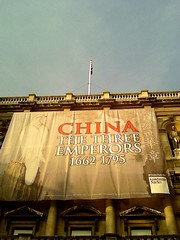
Royal Academy – China: The Three Emperors, 1662-1795

If you want to see great art, don’t go to the Chinese exhibition at the Royal Academy. If, however, you want to be entertained and delighted, surprised and enlightened, then this is an unmissable event.

From the first room, with its giant portraits of the emperors of the Kangxi, Yongzheng and Qianlong reigns* and the astonishingly crafted garments that match those they are wearing, you are dazzled with brilliant colours and swamped in the astonishing detail and craftsmanship that produced these lovingly preserved samples of what must be largely lost arts.

chinaAlmost everything in this extensive exhibition was made to the greater glory of these three men, or for their entertainment**. They appear again and again in different guises, sometimes as fervent Buddhists, sometimes as hunt-obsessed leaders of fierce nomads, sometimes as sober Confucian scholars. (Although the extremely formidable-looking Xiaosheng, Empress Dowager, painted in 1751 for her 60th birthday, does get an airing in this first room.)
Continue reading

Theatre Review: Blackout at the Courtyard Theatre

You are sitting in an Alcoholics Anonymous meeting. In the intimate space of the Courtyard Theatre at King’s Cross, you’re not just watching, you are in the meeting.

Seven alcoholics are telling their harrowing life stories – simply, naturally, with only as much melodrama as comes naturally to their characters.

Jack (Riley Stewart), from an Irish background, comes from a family of alcoholics, his mother dying at the age of 13 left him an orphan. (Earlier, his father had drowned in a puddle while in an alcoholic stupor.) Jack drank to forget; he drank to find a family. Of course both efforts failed.

Then there’s Tim (Gary Lawrence) who cries as he talks of his family – led by his macho football coach father – refusing to accept his homosexuality; he still can’t use the word “gay”. Then his story gets even darker.
Continue reading

The British Museum: The Oldest Writing in a Woman’s Hand?

A wonderful piece gets no special attention in the Roman Britain gallery at the British Museum but is well worth looking out for. It is one of the Vindolanda tablets, the hoard of letters found in the fort of that name on Hadrian’s Wall that preserves the details of the everyday life of the garrison and their wives.

This is a letter from Claudia Severa, wife of Aelius Brochus, the Vindolanda fort commander, to Sulpicia Lepidina, wife of the commander of a neighbouring fort. Most of the invitation to the birthday party is written by the garrison scribe, no doubt to Claudia’s dictation – his hand can be identified from other examples – but there’s a three-line personal note on the end in which Claudia adds a personal touch:

I shall expect you, sister. Farewell, sister, my dearest soul, as I hope to prosper, and hail.

(Sister seems to have been a term of endearment, rather than an expression of a family relationship.)

The gallery talk speaker, Sam Moorhead, suggested that this is the oldest surviving writing known to be in a woman’s hand — it is dated to between AD97 and 103 — which sounds about right to me.

« Older posts Newer posts »